

Part of the Rethinking Solana Infrastructure series. Written with DoubleZero.
TL;DR
- DoubleZero replaces the public internet with a dedicated fibre network purpose-built for blockchains and other high-performance distributed systems where milliseconds matter
- Their newest product, Edge, opens low-latency shred subscriptions to anyone, fully onchain
- Edge harnesses multicast technology, routing data by physical distance and replicating it only at the edges
- Validators can earn from the data they already produce, and traders can subscribe permissionlessly
- 409 validators (50% of the total stake) are already publishing shreds on the network
- Triton runs Edge alongside our own multicast fabric, racing both paths so our users always get the fastest stream
How the Solana stack fits together
In the last six years, Solana's write layer has been rebuilt for maximum performance, the ecosystem expanded from DeFi into gaming, payments, DePIN, and institutional settlement, and AI agents started sending transactions alongside humans.
But some layers underneath stayed where they were in 2020. The read layer is one, and we're addressing it with RPC 2.0: pulling reads out of Agave and rebuilding them as modular, independently scalable services. See the full breakdown in our first post in this series.
The network is another. The ecosystem has spent years squeezing microseconds out of software and tooling, but there has always been a ceiling on every optimisation: the public internet itself.
Until now.
DoubleZero set out to replace the public internet with a dedicated fibre network purpose-built for globally distributed systems like blockchain, delivering lower latency, higher efficiency, and accessible to anyone.
Before we get into how it works and why it affects your latency, here's where each layer sits in the stack:
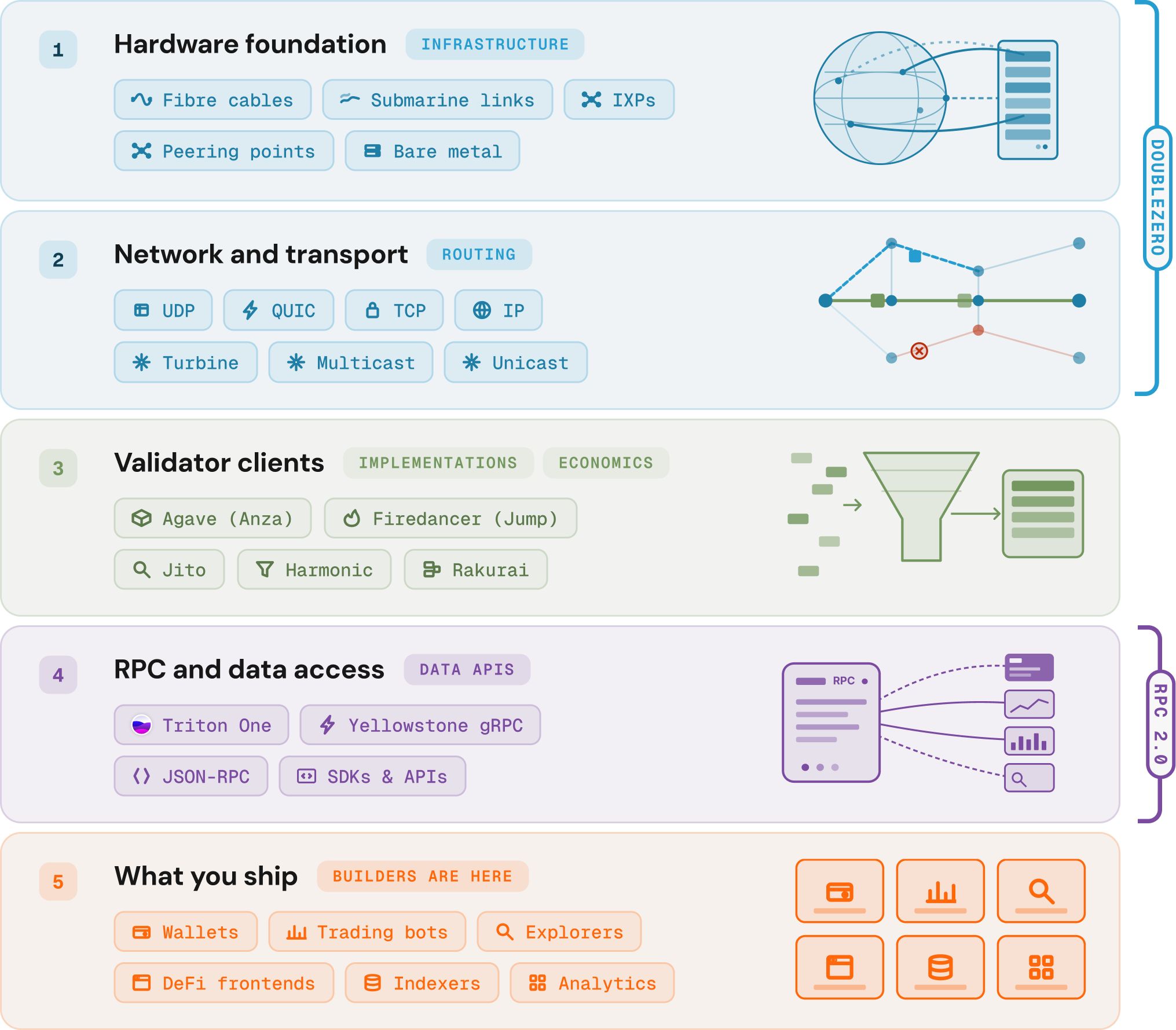
Why is the public internet not enough?
Solana's block production depends on shreds, small fragments of each block that the leader broadcasts through Turbine. The faster shreds propagate, the sooner everyone downstream sees what happened: a trading firm pricing an opportunity, an RPC provider indexing transactions, and a frontend refreshing state.
Propagation speed is the starting line. Everything else is latency added on top.
Operators across the ecosystem have optimised every layer from hardware tuning to premium networking in top-tier data centres. But the underlying delivery model still relies on the same public protocols and is subject to the same constraints.
Tom Warner from DoubleZero compared Solana's network model to traditional finance:
"If crypto systems are going to compete with centralised exchanges for liquidity and be the 24/7 venue for trading, we need to get better than centralised systems. They do two things really well: attract liquidity and have excellent connectivity. You know how long it takes to do a trade, and you know how long it takes to get data out of that system and analyse it.
When you have a geographically distributed blockchain, where every validator is the exchange floor for a few seconds, you get a really fractured experience as a trader: sometimes I get data fast, sometimes I get it slow, sometimes I don't get it at all."
What DoubleZero actually does
In simple terms, DoubleZero gives blockchain its own internet where:
- Traffic travels over dedicated fibre contributed by 14 independent operators spanning 30+ metro areas
- Routing and payments are coordinated through a decentralised ledger, so no single entity controls the network
- Any staked validator (verified through gossip) can connect for free and start publishing shreds
- Anyone can subscribe to the produced data feeds and start receiving fast shreds
DoubleZero started on the write side. Validators connected to it to receive transactions over dedicated fibre, bypassing the public internet. That made inbound delivery faster, but didn't touch how shreds propagated outward. Turbine's fanout tree and stake-weighted ordering stayed exactly the same.
Edge changes the delivery method entirely: validators publish their shreds into DoubleZero's network, and multicast handles replication at the hardware level, optimising delivery for maximum geographical efficiency.
- Everything is verifiable on-chain: delivery performance, revenue splits, network health
- Validators can get revenue from the data they already produce
- Subscribers go live in two steps: pay onchain in USDC, start receiving.
What is multicast, and how does it compare to Turbine?
Multicast isn't new. Traditional finance has relied on it for decades, and Triton uses it internally across our own infrastructure. What DoubleZero did was make it open and global, challenging Solana defaults like Turbine.
Under Turbine, shred propagation works as a fanout tree. The leader sends shreds to a root node, which forwards to a subset of validators, who forward to another subset, until every node has a copy. The tree is ordered by stake weight, meaning a high-staked validator in London gets shreds before a low-staked validator in the same data centre as the leader. A shred from Singapore might route through London, then Los Angeles, then back to Singapore, with every extra hop adding latency. The problem compounds as more nodes join the network.
With multicast, the leader transmits once into the DoubleZero network, and switching hardware replicates the data at the last hop, as close to the receiver as possible. Delivery is determined by physical distance from the leader, with new validators only adding work at the edges, allowing the network to scale without slowing down.
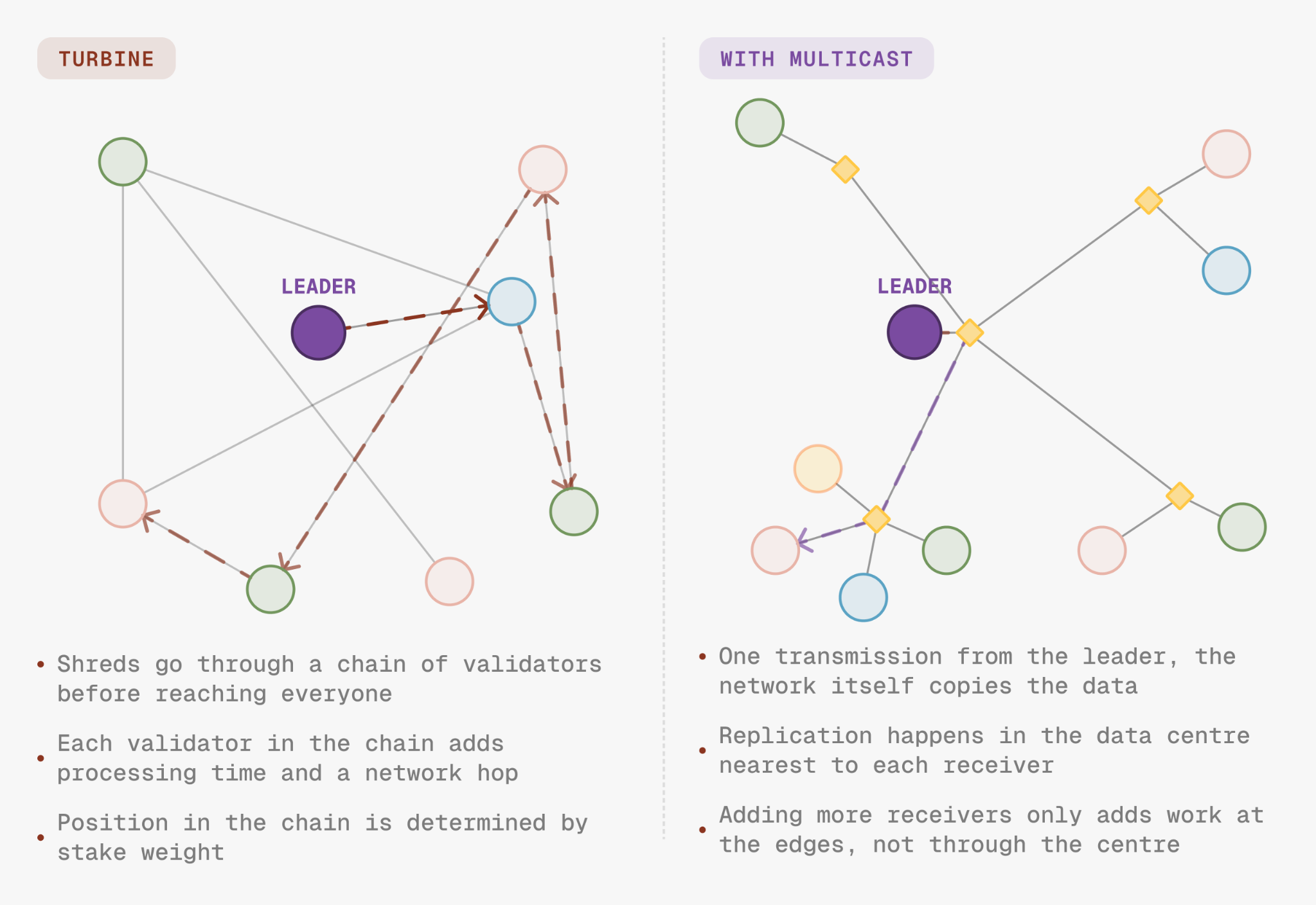
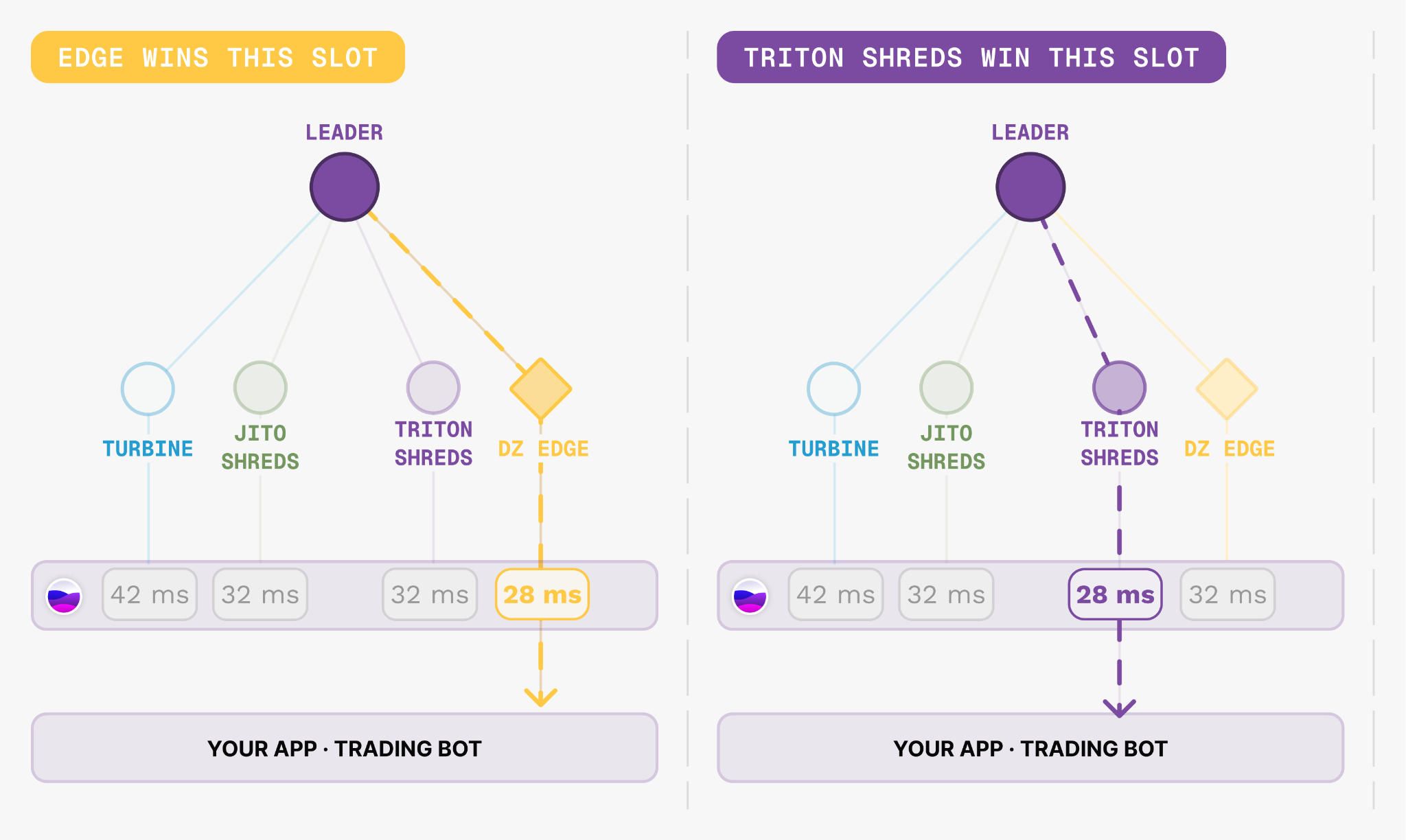
When a DoubleZero-connected leader produces shreds, multicast delivery over DoubleZero Edge wins roughly 90% of the time against other methods, measured from major trading centres.
You can explore live multicast propagation data on DoubleZero's multicast dashboard. It does a great job visualising shreds in transit, and it's honestly pretty fun to watch.
What does this change for the read layer?
At Triton, we serve many traders. It's a zero-sum game where being first matters above all else, so we shave every millisecond we can off both ingesting chain data and sending transactions to the leader.
For that reason, we've been running DoubleZero Edge alongside our own multicast fabric across every point of presence since the early stages.
Our shred routing races multiple sources against each other: DoubleZero Edge, Jito ShredStream, Turbine, and our own leaders. Whichever shreds arrive first feed into a single system, and internal multicast delivers them to every RPC node in the data centre.
This way, every customer gets the fastest available stream.
If you're building on Solana, none of this requires changes to your code. But here's what's improving under the hood.
Open economics, open participation
Before Edge, Solana's shred economy was a private club. Trading firms negotiated deals with large-staked validators near the top of the Turbine tree. Smaller validators' shreds weren't worth the effort. Fast data was gated by stake, relationships, and colocation budgets.
Edge opens this market. Hundreds of validators publish into a shared multicast group, and the collective coverage becomes the product. A 0.1% validator fills in the picture just as well as a 5% one. Any validator can earn. Any trader can subscribe.
The revenue model funds the full stack: after a protocol burn, fees are split between fibre operators (50%), validators (32.5%), and client development teams like Jito and Anza (17.5%). Brian, Triton's co-founder, said, "I do think it's pretty cool that you guys are sharing some of the proceeds with the client software developer teams. And so you're supporting the open source work that is supporting the blockchain."
That's the model we want to see more of.
Where is this going?
Edge launched with shreds because they're the most time-sensitive data in Solana. But shreds are just the first feed on a permissionless multicast platform.
Equities data, commodities, pre-confirmation signals from block engines, and feeds from future proposers and attesters could all run on the same infrastructure, turning it into a universal data layer for anything that needs fast, verifiable delivery.
Even Solana's next consensus protocol needs this. While very different from Turbine, Alpenglow's Rotor still lacks native geography-awareness. DoubleZero fills that gap, making it as relevant to fast and open data access as it is today.
Conclusion
In 2026, Solana's infrastructure is being rethought, layer by layer.
- Alpenglow (by Anza) overhauls consensus, dropping finality from 12.8 seconds to ~150ms by moving votes off-chain and retiring Proof of History and Tower BFT
- RPC 2.0 (by Triton One) pulls the read layer out of the validator and rebuilds it as modular, independently scalable services for faster and more affordable data access
- Edge (by DoubleZero) replaces the public internet with dedicated fibre, creating a new revenue stream for validators and opening the shred market to everyone
Three foundational layers, all open, all shipping in 2026.
This is the second post in the Rethinking series. Next, we're going deeper on RPC 2.0, so stay tuned!