

We’ve got some big news to share! We’ve retired Cascade Marketplace and cancelled all standing bids as of February 28th. This doesn't mean we stopped providing staked sending; it just means we stopped charging for it.
Recent Anza improvements have significantly increased bandwidth for staked senders, letting us deliver Cascade-level transaction performance to far more users. So instead of running SWQoS as a paid product, we're making it the default for every Triton customer at no extra cost.
Our north star, driving everything we build, is the best possible service for every customer. This change is no different. Let's break it down.
How SWQoS works and why it's changing
SWQoS is a Solana innovation developed by Anza that protects validators from spam by prioritising transaction traffic without slowing the network. The Agave client splits a validator's bandwidth between senders with stake (2,000 connections) and without (500 connections). If your identity is backed by SOL, you get guaranteed bandwidth proportional to your stake. If it isn't, you share a fixed pool with every other anonymous sender: 200 TPS across up to 8 connections.
Cascade was Triton's stake-weighted bandwidth marketplace, which gave customers priority sending without running a validator themselves. You'd purchase bandwidth backed by staked identities, and your transactions would be routed through our optimised pipeline with that stake attached. We spent years perfecting it: minimal hops, optimised forwarders and load balancers. Meanwhile, across the industry and on Triton's own unstaked paths, transaction forwarding still went through standard RPCs.
Yellowstone Jet, the sending engine behind Cascade, has been open source since last year, but was only available as a standalone binary. We've now modularised it into a crate, making it much easier to integrate direct-to-leader sending into your own stack – no stake weight required. That was our first step toward making transaction landing faster and more reliable for everyone.
Anza's continuous improvements to Agave reinforced that direction, reducing how much stake is needed to achieve the best performance possible. With the upcoming Solana 4.0 release (planned for March), SWQoS will become a congestion-only backstop: the network will no longer split capacity between staked and unstaked traffic under normal conditions, and it will activate only when a block producer's TPU reaches 90% capacity. The planned 4.1 release continues the trend with deterministic token buckets and bandwidth redistribution.
At the same time, JitoBAM (60% of active stake), Harmonic (16%), and Firedancer are actively working on different ways to guard TPU without relying entirely on SWQoS, bringing us another step closer to a world where stake-weight gating is no longer the primary protection mechanism.
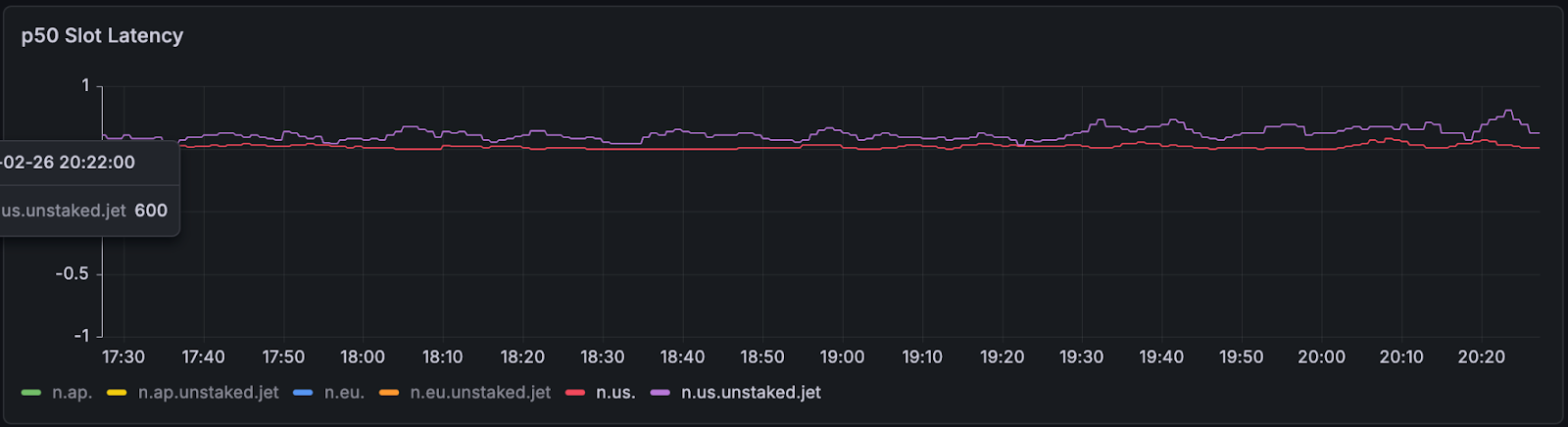
Our latency tests tell the same story. At p50, staked and unstaked sending perform nearly the same (see image below), and any remaining gaps are covered by Triton's staked fallback, now included for every subscription.
What this means for your transactions
This spring, we're transitioning all transaction traffic to our Jet instances. Here's what that means for you:
1. All transactions going straight through Jet. Every sendTransaction call on Triton will go through Jet, our sending service that tracks the leader schedule in real time, pre-connects to upcoming leaders over QUIC, and delivers your transactions with as few hops as possible.
2. Staked routing included by default. All customers, including those who never used Cascade, now automatically get stake-weighted routing. No extra configuration or action needed
3. Faster path for everyone, including Cascade users. We streamlined the pipeline by removing marketplace connections, stake-level routing, and Cascade vs non-Cascade filtering, giving your transactions an even simpler and faster path with no change in landing rates.
For latency-sensitive workloads
If you're running arb strategies, liquidation engines, or anything where milliseconds matter, consider integrating the Yellowstone Jet TPU client directly into your backend.
Note: pre-Agave 4.0, stake weight still makes a significant difference even though unstaked performance has improved a lot. After 4.0, we expect the gap to narrow, making Jet TPU a stronger choice for latency-sensitive workloads.
There's no intermediary in that path at all, and Jet handles QUIC handshakes, manages connection caching without lock contention, tracks leader schedules, and supports transaction callbacks, contact info overrides, blocklist/allowlist controls, and multi-step identity updates out of the box.
The library is open source, the docs are public, and the deep-dive walkthrough covers everything from setup to sending your first transaction.
Yes, this means fewer billable calls on our end, but we're recommending it anyway, because the right answer for latency-sensitive workloads is the one that gets you closest to the leader.
Frequently asked questions
Will my landing rates or latency change if I used to be on Cascade?
We've simplified the path your transactions take, so they now make fewer hops. Your landing rates stay the same, and latency should improve as we roll this out.
Will my landing improve if I wasn't on Cascade?
Yes. We're gradually rolling out Jet routing for all customers. You should see faster transaction sending this month as the transition continues.
What is SWQoS?
Stake-Weighted Quality of Service is a transaction traffic control mechanism that reserves capacity for packets coming from staked validators, in proportion to their stake. It protects the network from spam and ensures reliable delivery during congestion. With Anza's upcoming changes, the static 80/20 split becomes a dynamic fallback that only activates under load.
What was Cascade?
Cascade was Triton's stake-weighted bandwidth marketplace. Customers purchased bandwidth backed by staked validator identities for priority transaction delivery. Its routing engine, Jet, is now the default for all Triton customers, with stake-weighted routing included at no extra cost.
What is Jet?
Jet is our high-performance transaction relay engine. It tracks the Solana leader schedule in real time, pre-connects to upcoming leaders over QUIC, and sends transactions with minimal latency. We also released it as a standalone Rust TPU client crate, so teams can integrate the same battle-tested sending logic directly into their own stack. It supports transaction tracking with callbacks, TPU contact info overrides, sending to arbitrary peers, multi-step identity updates, and blocklist/allowlist controls.
Can I run Jet myself?
Yes. The Yellowstone Jet TPU client is open source and available as a Rust crate. If you want the lowest possible latency, integrating it directly into your backend removes all intermediaries (keep in mind, that pre-Agave 4.0, stake weight still makes a significant difference).