
Comprehensive guide to white-label validators on Solana

TL;DR
- White-label validator services let you run a branded Solana node without managing operations, hardware, upgrades, or failover.
- If you do not have, or plan to have, at least 150,000 SOL in stake (estimated at the time of writing), you should consider delegating to another validator, as running your own would operate at a loss.
- Most popular use cases for validator-as-a-service (VaaS) are institutional treasury funds, DeFi applications, DAOs, protocols, and non-profits.
- Key separation is non-negotiable if you want to remain in control of your funds. If the provider holds your withdraw authority, you are essentially an unsecured lender.
- APY is how much money your validator makes you and your delegators. Uptime, skip rates, and Jito MEV optimisation define your APY.
Introduction
A Solana validator does 3 things: it votes every block (~400ms) to secure consensus, it produces blocks when selected as leader (earning transaction fees, priority fees, and MEV tips), and it votes on SIMDs and governance proposals.
If you are considering running one, you already know the first 2 (the ones that generate revenue) require constant operational attention: client upgrades, skip rate monitoring, health checks, hardware tuning, and failover management during network events.
That is where white-label services come in. It is the infrastructure equivalent of ghostwriting: the provider handles operations while you:
- Control branding. Your validator name appears in explorers and on-chain.
- Set commission. You decide the fee structure that works for your P&L, regulatory requirements, or delegator expectations.
- Participate in governance. You influence the protocol direction by voting on SIMDs and governance proposals.
Who needs a white-label validator?
On Solana, you have 3 paths for staking. Here is how the economics and operations compare.
| Dimension | Self-hosted | White-label | Simple delegation |
|---|---|---|---|
| CapEx | High (servers, NVMe, network) | None | None |
| OpEx | $3,000–$5,000+ / month + labour | Based on the agreement | None |
| Control | Full (hardware, OS, client, region) | Limited | None |
| Withdraw key custody | Full | Full (if provider supports it) | Zero |
| Commission | 100% | 100% | ~90–100% |
| Risk profile | High (operational + custody) | Low (custody only) | Low |
When each option makes sense
Self-hosted. Makes sense when you have large stake volume, an in-house DevOps team, and a need for maximum control over infrastructure.
Simple delegation. Makes sense for smaller players, retail holders, or DeFi-native users who have less than 150,000 SOL to stake and prioritise yield over brand visibility and governance.
White-label. Makes sense for anyone holding over 150,000 SOL without DevOps resources. The most common audiences:
Institutional treasuries and funds
If you hold a substantial SOL amount (150k+), paying 0% commission to yourself via a white-label node is often cheaper than paying 5–10% commission to a public validator. You also gain governance power and brand visibility on-chain.
Consumer dApps
Apps like Phantom, or exchanges, need to offer staking to their users. By using a white-label provider, they can spin up their own branded validator, collect fees from their user base, and offload the operational burden to infrastructure specialists.
Protocols and non-profits
Running a validator allows DAOs and non-profits to generate sustainable revenue from their community’s stake rather than relying on finite grants. It turns community support into an operational runway.
The break-even math behind running a validator
Before evaluating providers, you must understand the break-even math.
Revenue sources
| Revenue source | How it works |
|---|---|
| Inflation rewards | Solana creates new SOL through inflation (currently ~4.5%, targeting 1.5% long-term). Your validator share is proportional to stake and vote credits. |
| Block rewards | When your validator is awarded a leader slot (frequency is proportional to stake), you earn 50% of base transaction fees for producing a block. Adds ~0.37% APY (estimated). |
| Priority fees | Users add priority fees to expedite transactions, and the leader receives 100% of them. Adds ~0.3–0.4% APY (estimated). |
| MEV (Jito tips) | If running a Jito-Solana client, you capture MEV tips from searchers. Adds ~1–1.5% APY on average, with peaks of 13–15% during high-activity periods (estimated). |
| Commission | Your cut of inflation rewards earned by SOL delegated to your validator, typically 0–10%. |
Expense sources
| Expense source | Cost |
|---|---|
| Vote fees | Fixed cost: 0.000005 SOL per vote, or ~1 SOL per day (~350–400 SOL per year). This cost is identical whether you have 1 SOL or 10 million SOL staked. |
| Hardware and hosting | $3,000–5,000+/month for quality bare-metal servers in well-connected data centres (~250–420 SOL/year, estimated). |
| Ops and labour | DevOps, optimisation, monitoring, upgrades, and 24/7 incident response. Variable, and commonly underestimated. |
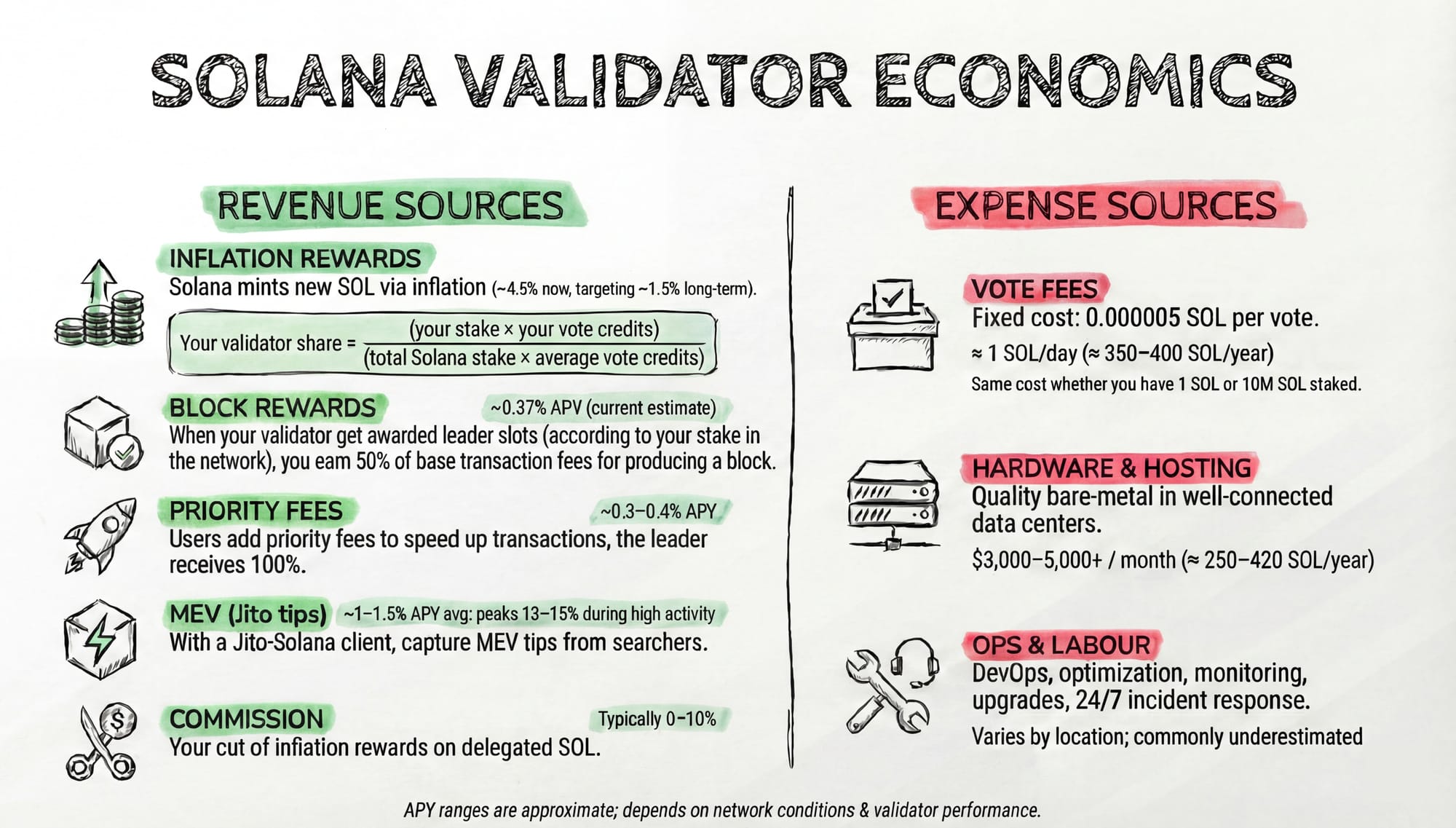
The core takeaway on validator economics
Inflation rewards are distributed proportionally to all staked SOL across the network. Running a validator does not give you extra inflation rewards—it lets you earn fees on top of what you would get by delegating elsewhere.
The break-even stake depends on the effective fee yield—the APY validators earn specifically from transaction fees and typically do not share with stakers. At the time of writing, this sits at roughly 0.37–0.4%.
Break-even estimate. At 0% commission and ~0.4% effective fee yield, break-even stake ≈ 150,000 SOL (600 SOL / 0.4%).
Selecting a provider: 3 core criteria
Once you have confirmed the economics work for your stake, evaluate providers across these dimensions: security, privacy, and performance.
Funds custody and security
A Solana validator uses 3 keypairs:
- Identity and vote account keys (hot). The provider must hold these. These keys must be on the server to sign blocks and votes in real time. If the provider loses these, your node goes offline, but funds remain safe.
- Withdraw authority (cold). Must be generated and held by you. This key controls where rewards go and is required to withdraw the vote account’s balance.
- Staker authority. Delegation control should be held by you when your compliance model requires it.
Non-negotiable rule. If a provider asks for your withdraw authority “for easy setup”, walk away. They are effectively taking custody of your revenue stream.
Privacy and discretion
A proper white-label provider acts as your ally. They should never use your brand in their marketing without explicit consent, and your node should appear entirely sovereign on explorers like Solana Beach or validators.app.
- Need-to-know basis. If you require it, only essential employees should know your identity. Proper providers can enforce strict internal access controls.
- Historical track record. If discretion matters, choose providers who have never leaked client information, or used client brands for self-promotion without permission.
APY: the performance metric
Uptime is just one metric. A validator can respond to pings while failing to produce blocks. You should also ask about skip rate, MEV capture, and block packing.
- Skip rate. The % of time your validator failed to produce a block. High skip rate means lost block rewards. Network average is ~0.07–0.17%, while top providers achieve ~0.05% (estimated). You want a provider that tunes for network latency and peers directly with high-stake nodes.
- Jito and MEV. If you want to maximise returns, look for a provider running the Jito-Solana client (or compatible), which captures MEV tips from searchers. Today, ~90% of validators run Jito or a compatible client (estimated).
- Block packing. Hardware must be powerful enough (CPUs, RAM) to pack transactions efficiently during high-traffic events. More transactions packed means more priority fees captured. If the CPU chokes, you drop transactions, and APY suffers.
- Uptime. Reliable providers target 99.9%+ uptime through redundant hardware, premium data centres, and automatic hot-swap backup systems that move the validator key and tower file immediately when a node fails.
The bottom line
For protocols, dApps, and institutions with sufficient stake—and a need for brand visibility, governance participation, or regulatory positioning—a white-label validator makes strategic sense.
In practice, the provider you choose determines whether that validator remains secure, performant, and economically sustainable long term, so choose carefully.